Artist
Unknown
The station hotel painting
12/9/2026
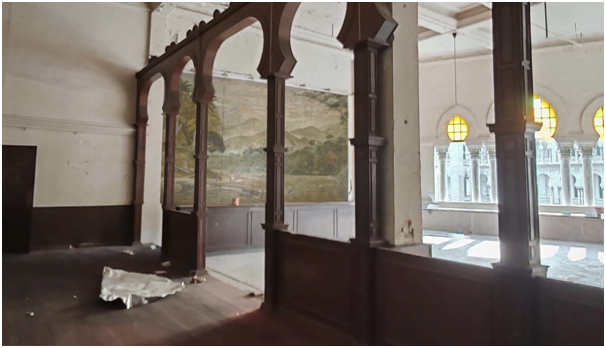
Kuala Lumpur’s grand railway station is a true heritage
landmark of Malaysia; it was built in 1917 and was designed
by A.B.Hubback in the Mughal Eclectic style.
The
station itself remains in full operation to this day, but
within its walls behind locked doors, is also its old hotel
which had been closed down and left derelict for a number
of years.
The hotel had suffered years of decline before closing,
becoming known more for its ropey budget accommodation and
was popular too with photographers for its colonial era
time capsule like décor.
My own visit to the hotel was in 2014, by then the space
had sat vacant for at least 3 to 4 years, enough time for
the destructive effects of the humid climate to have left
its mark on everything inside. I was interested in seeing
how much of the buildings period features and fittings remained,
the parts that helped link a space directly back to its
past.
The hotels original main wooden staircase and even its archaic
cage lift was still in place, but so much else had been
changed and renovated over the years.
It was in the former lounge space upstairs where I first
saw something very special, a large landscape painting.
At first I assumed the artwork was just a drab contemporary
backdrop, but on closer inspection it was clear that this
was something very old that had been executed by a skilled
hand. The painting was unsigned and the surrounding walls
was devoid of any clues that could reveal more information
about it. It left me intrigued.
Over
the following years I thought many times of that old painting,
when in August of 2026 I came across an art conservation
article in The Star newspaper¹ ; the lead photo was
none other than the painted landscape scene I had seen all
those years before!
Someone had thankfully seen fit to save it and the artwork
was now hanging inside Malaysia's National Art Gallery.
Later, I was able to learn that the painting had in fact
been part of their NUSA (Homeland) exhibition for at least
3 - 4 years.
What surprised me the most was that the landscape remained
unattributed and was labelled simply as - Artist : Unknown
That was funny to me, because by that time I had already
found out the who and the why; the mystery had simply been
far too enticing not to have done some investigating!
Julius Wentscher was a painter from Germany, he was born
in Konigsberg in 1881 and was the son of a well known East
Prussian landscape painter, also named Julius Wentscher
(1842-1918). Julius the Younger received his artistic training
at the Académie Julian in Paris.
Julius was married to Tina Haim-Wentscher, a sculptor who
had studied in Paris, Vienna and Berlin and was associated
with the Berlin Secession artists group. Tina was born in
Constantinople in 1887 to Czech parents of Turkish-Sephardic
Jewish background.
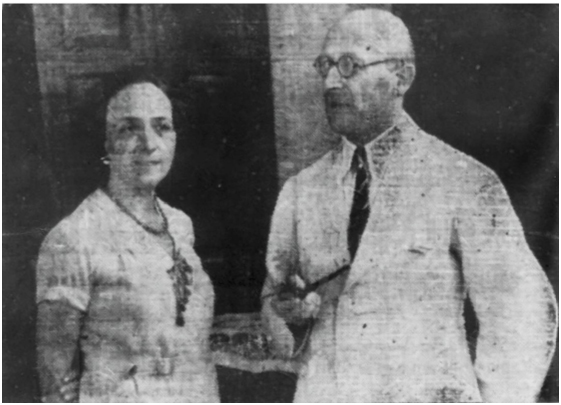
Courtesy of The Straits Times, 12 February 1936
From 1921, the
couple had enjoyed joint painting and sculpture study trips
abroad to Greece, Italy and as far away as Bali and Java.
In 1931, they travelled to Hong Kong, Shanghai, Beijing
and Bangkok, making their art and exhibiting work as they
went.
Whilst they had been away from home, things were rapidly
changing in Germany; National Socialism was taking over,
making it increasingly fraught for all those the Nazi's
opposed.
It was from the concerned warnings of Tina's friend, Käthe
Kollwitz and even Julius's own mother, that the couple decided
not to return home for the foreseeable future.
Tina's Jewish background was an obvious concern, but so
too was it for Julius. The mere fact that he was married
to Tina would have categorised him by the Nazi's as, "Jüdisch
versippt" (family ties to Jews). Both of them would
have surely been persecuted if they had returned.
The Wentscher's forced self-exile saw them move on to Singapore
and Malaya in 1936. There, they further grew their artistic
reputations, holding successful exhibitions and undertaking
private and official commissioned projects. Tina completed
several reliefs for public buildings, whilst Julius painted
the installations of the Sultans in Perak and Selangor,
as well as work in Singapore, such as the portrait of Sir
Song Ong Siang (1871-1941), which now hangs in the National
Museum of Singapore.
Possibly the couples largest joint commission, was creating
life size realistic diorama scenes of Malay craft and Malayan
industry, for the 1938 Empire Exhibition in Glasgow.
A few months after the couples arrival in Singapore, they
conducted their first major study trip to the East Coast
of Malaya, to Kelantan and Terengganu. The trip lasted four
months and Julius brought back a number of paintings in
water colours and oils. The Wentscher's would later exhibit
their completed East Coast work to great success, with many
pieces being sold, including one artwork going to the British
Resident, no less.
A year later, the Wentscher's adventurous side was sparked
again and another painting and sculpture expedition was
organised. The couple would return to Kelantan, but this
time it would be far from the coast and into the wilds of
Malaya's central interior, using the Kuala Pergau Estate
as base camp. From there they spent several weeks making
frequent expeditions down the Galas river, passing rapids
and visiting the Temiar aboriginal groups of Perak and Kelantan.
In a later postwar interview, Tina would recall how she
was the sole female in the party and how the locals would
build them bamboo huts.
In March 1939, Julius's station hotel painting first made
its public appearance. The hotel had just undergone an extensive
refurbishment and the artwork was to complement the modernised
and updated facilities. The painting measured '21 ft x 11
ft' (640 cm x 335 cm) and had taken Julius two months to
complete.
The landscape was described as a Kelantan river scene, so
one could assume that the location for its setting may well
have been found during the Wentscher's Galas river expeditions
in 1937.
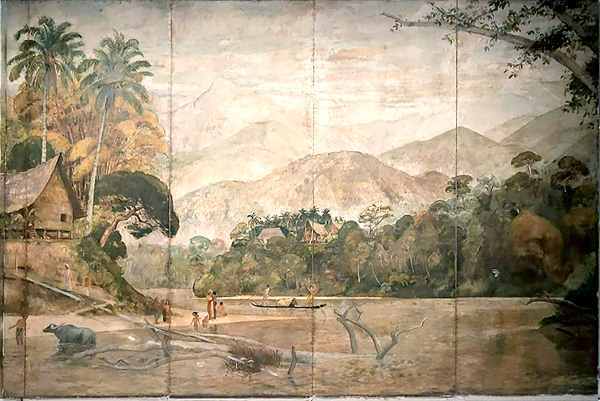
The painting shows a bend in a river as it lazily flows
its way through a lush tropical jungle scene.
In the background are thick forested hills that grow in
height leading the eye off into the distance towards the
majestic Gunung Tahan, Peninsular Malaysia's highest peak.
In the foreground on the hillsides are houses capped with
tall steep sided roofs. Local inhabitants can be seen down
by the rivers bend, as a long-boat is slowly punted passed
them. Not far away to the right, your eye is then caught
by a tiny movement, as a blue-banded kingfisher flits across
the water.
On the rightmost panel, just visible, is the East Coast
Express train as it threads its way through the thick forested
hill scape, behind.
But there's a big problem, we can't see any of this specific
scene because the right most panel is completely missing!
We only know of the panel’s presence because of two
key 1937 newspaper articles. The reports give us a brief
description of the paintings composition² , its overall
dimensions and a rather helpful photograph³ of the
work in its entirety. Without this, we may well have been
none the wiser.
The lost section would have roughly measured 131 cm in width
and 341 cm in height.
Below is a picture Illustrating the loss using a copied
section from the original black and white newspaper photo,
combined together with the painting as it appears today.
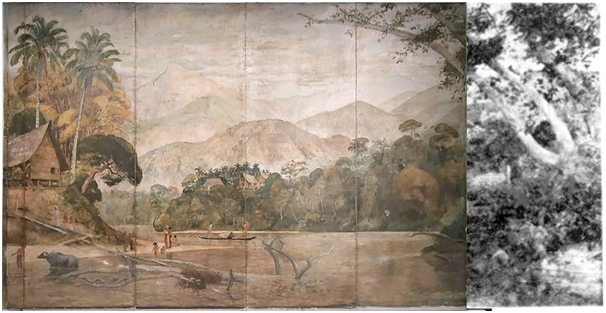
So, what happened to the lost panel? At this point in time,
I just don’t know.
Six months after the station hotel painting had been unveiled,
the Wentscher's idyllic world in the Far East began to quickly
unravel, when war was declared between Britain and Germany.
The Wentscher's were living in Singapore where there was
already a population of German and Austrian refugees who
had fled Europe, many of whom were Jewish.
The
British administration quickly grew uneasy with this group
living in their midst's, theorising that any one of them
could become an enemy collaborator. From then on the Wentscher's
and the refugees officially became designated as 'enemy
aliens' and were all marked for deportation. One can only
wonder what the Wentchers's thought about all of this, considering
that on many occasions the colonial elites had rubbed shoulders
and even bought and commissioned work from them.
All
appeals by the refugees to halt their expulsion was in vain,
and on the 18th of September 1940, the Wentscher's, together
with around 295 men, woman and children were expelled from
Singapore. They left their tropical oasis on the converted
troop ship, the Queen Mary. They made passage for Sydney,
Australia, where the group eventually found themselves in
an internment camp in a town called Tatura in Victoria.
Having
been unable to bring most of their artwork with them, the
Wentscher's had left much in storage in Singapore, but it's
thought that not many works survived the war, making the
station hotel painting all that more precious.
In 1942,
the deportees were still languishing in captivity when news
broke that Singapore had fallen to Japanese forces. It was
only then did they realise that their whole ordeal had in
fact been a huge blessing in disguise, saving them from
the horrors of war and Japanese captivity.
Later
that same year, their blessings continued when they were
all finally released and allowed to settle in Australia.
The Wentscher's chose to live in Melbourne, obtaining Australian
citizenship in 1946.
Julius continued with his painting, specialising in landscapes,
portraits and depictions of horses. Julius would pass away
in 1961. Tina would out live him and arguably became a far
more recognised and accomplished artist in her own right,
passing away in 1974.
The works of both artists can still be found today at auction
as well as in private and public collections around the
world.
Julius's Kelantan river scene had survived over 80 years
in that same space. There, it sat through a war and lingered
for decades in relative obscurity just waiting to be remembered
again, and when it was, so too was the story of Julius and
his wife Tina and their remarkable life.
Copyright 2026©
Raz Talhar

|


